A Photograph Raises New Questions About Bizimana and the Bocsánczy Case
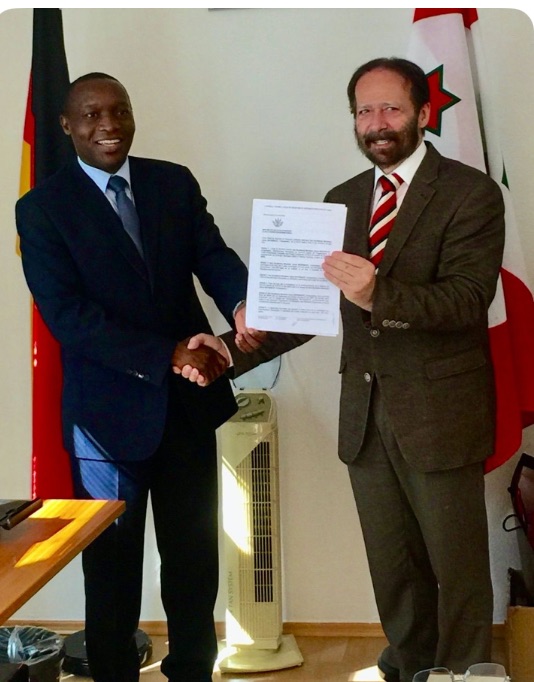
A newly surfaced photograph appears to show Édouard Bizimana and János Bocsánczy together during Bizimana’s diplomatic posting in Europe. Its provenance and context remain unverified, but the image adds new urgency to questions over how Bocsánczy was appointed, accredited and supervised as Burundi’s representative in Vienna.
The questions surrounding Burundi’s current Foreign Minister, Édouard Bizimana, and the Hungarian criminal proceedings associated in press reports with János Bocsánczy have acquired a potentially significant new element, although its provenance and authenticity have yet to be independently established. [6]
What the Photograph Can and Cannot Establish
A photograph described by the source that supplied it as having originated from open-source material shows two men shaking hands in front of the flags of Germany and Burundi, while one of them holds a paper document.
According to the identification provided with the image, the man on the left is Édouard Bizimana and the man on the right is János Bocsánczy. Public records independently establish that Bizimana served as Burundi’s ambassador to Germany, presented credentials as ambassador to Austria in January 2014 and, in September 2014, presented credentials as Burundi’s Permanent Representative to UNIDO in Vienna. German Federal President accreditation record[1] Austrian presidential credentials record[2] UNIDO credentials record[3]
.jpg?utm_source=diplomatico.news)
The image itself does not establish the identities attributed to the two men. Nor is the content of the document legible. The version obtained by this publication carries no traceable caption, date or original publication source capable of independently establishing when, where or why it was taken.
Those missing elements matter. If the original source, date and context can be recovered, the photograph could become important documentary evidence. Until then, it should be treated as an image requiring authentication rather than as proof of the circumstances it appears to depict.
What is independently established is that Bocsánczy was representing Burundi in Vienna by September 2015. An official International Atomic Energy Agency participant list[4] identifies János Bocsánczy as Burundi’s ambassador and resident representative to the IAEA and as head of the Burundian delegation.
Hungarian prosecutors later alleged that, between 2016 and 2021, an unnamed Hungarian man promised five foreign nationals that he could obtain honorary-consular or special-envoy positions for them through officials in African and Oceanian countries in exchange for payment. Prosecutors said two individuals obtained the positions and that the defendant received €213,395. Hungarian prosecution announcement, 29 January 2024[5]
The prosecution announcement does not publicly name Bocsánczy. The connection to him derives from Hungarian press reporting, including HVG’s identification of the defendant as “B. János” and its description of his previous honorary-consular role and subsequent representation of Burundi at the IAEA. HVG report on “B. János” and the indictment[6]
These remain allegations contained in a criminal prosecution, not a conviction.
The photograph nevertheless raises an obvious question: if the source identification is correct, what was the institutional context of the meeting between the two men, and what was the document being exchanged?
That question becomes more relevant when considered against the standards of political and diplomatic accountability applied elsewhere.
Diplomatic Accountability Beyond Burundi
In Kenya in 2010, Foreign Minister Moses Wetang’ula stepped aside while allegations concerning the acquisition of diplomatic properties were investigated. A parliamentary committee had recommended that he take political responsibility and leave office while the relevant authorities investigated the transactions. Wetang’ula denied wrongdoing. Reuters report on the Kenyan embassy investigation[7]
The significance of the episode is therefore not that guilt had already been established, but that unresolved questions concerning the administration of a foreign ministry were considered serious enough to produce a temporary political consequence.
More recently, Norway’s ambassador to Jordan and Iraq, Mona Juul, stepped down in February 2026 following scrutiny of her past contacts with Jeffrey Epstein. Norway’s Ministry of Foreign Affairs said those contacts demonstrated a “serious lapse in judgment” and made it difficult to restore the trust required for the role, describing her departure as the right and necessary decision. Norwegian Ministry of Foreign Affairs statement[8]
The United Kingdom offers a different but relevant example of institutional accountability. In April 2026, Sir Olly Robbins left his position as the Foreign Office’s most senior civil servant amid controversy over the security vetting of Peter Mandelson, the former British ambassador to Washington. Robbins’ departure followed scrutiny of the Foreign Office after Mandelson received clearance despite an adverse recommendation from UK Security Vetting. Reuters report on the Mandelson vetting dispute[9]
The controversy concerned institutional responsibility for a sensitive appointment and clearance process rather than an allegation that Robbins had personally engaged in the conduct attributed to Mandelson.
These cases do not establish a universal rule that an official must resign whenever someone with whom they had professional contact later becomes the subject of criminal allegations. They do, however, demonstrate that diplomatic appointments, vetting procedures and failures of institutional judgment can themselves become matters of public accountability.
A broader investigation by the International Consortium of Investigative Journalists and ProPublica illustrates why scrutiny of appointment and supervision procedures can be warranted. Their 2022 Shadow Diplomats investigation[10] identified at least 500 current or former honorary consuls who had been accused of crimes or embroiled in controversy. The cases included allegations involving corruption, fraud, drug and weapons trafficking and links to terrorist organisations.
Bocsánczy’s diplomatic history makes those questions particularly relevant. Official IAEA records establish that he represented Burundi in Vienna, while Hungarian prosecutors describe an unnamed defendant whose diplomatic history and alleged conduct have been connected to Bocsánczy in Hungarian reporting. IAEA participant list, September 2015[4] Hungarian prosecution announcement, 29 January 2024[5] HVG report linking the indictment to “B. János”[6]
What remains missing is the administrative chain explaining how Bocsánczy obtained and retained his Burundian diplomatic status.
What Burundi Should Clarify
Bizimana now serves as Burundi’s Minister of Foreign Affairs, Regional Integration and Development Cooperation. Burundi’s Presidency currently identifies him in that position[11].
The photograph therefore deserves a clear response, not because it proves wrongdoing, but precisely because its meaning remains unresolved.
Burundi’s Presidency and Ministry of Foreign Affairs could clarify the matter by establishing whether the source identification of the photograph is correct; when and where the image was taken; the purpose of the meeting; the nature of the document shown; and whether that document formed any part of Bocsánczy’s appointment, nomination or accreditation process.
Bizimana himself could likewise state whether he is the person identified in the photograph and, if so, explain the circumstances in which it was taken.
None of those questions presumes criminal responsibility. There is currently no publicly established evidence that Bizimana participated in the offences alleged by Hungarian prosecutors.
But transparency is particularly important where diplomatic credentials and public authority are concerned. If the photograph depicts an entirely routine diplomatic encounter, documentation and context should make that clear. If it relates to Bocsánczy’s appointment or accreditation, that too is a matter that Burundi’s institutions should be able to explain.
Until the image is authenticated and its context established, it is evidence of a question, not an answer.
And that question deserves a documented response.
References
- [1] Bundespräsidialamt — Office of the Federal President of Germany (2012). Accreditation of Édouard Bizimana as Ambassador of Burundi to Germany.Primary source ↩
- [2] Österreichische Präsidentschaftskanzlei — Presse- und Informationsdienst (2014). Presentation of Édouard Bizimana’s credentials as Ambassador of Burundi to Austria. OTS0168 / OTW0168.Primary source ↩
- [3] United Nations Industrial Development Organization (UNIDO) (2014). Presentation of Édouard Bizimana’s credentials as Burundi’s Permanent Representative to UNIDO. Flickr photo ID 15258303732.Primary source ↩
- [4] International Atomic Energy Agency (IAEA) (2015). IAEA General Conference, 59th regular session — List of Participants. GC(59)/INF/10.Primary source ↩
- [5] Központi Nyomozó Főügyészség — Central Investigating Chief Prosecutor’s Office (2024). Charges brought in an international corruption case.Primary source ↩
- [6] HVG Kiadó Zrt. (2024). HVG report linking the indictment to “B. János” and Burundi’s IAEA representation. ↩
- [7] Reuters (2010). Top Kenyan officials step aside over embassy scam. ↩
- [8] Ministry of Foreign Affairs — Government of Norway (2026). Mona Juul Steps Down as Ambassador.Primary source ↩
- [9] Piper, Elizabeth & Tabahriti, Sam (2026). UK’s top foreign ministry official to step down after Mandelson vetting dispute. Reuters. ↩
- [10] Fitzgibbon, Will, Cenziper, Debbie, Reuter, Delphine, Herscowitz, Eva, & Anderson Stern, Emily (2022). Shadow Diplomats: global investigation into controversial honorary consuls Primary URL. International Consortium of Investigative Journalists (ICIJ). Shadow Diplomats. ↩
- [11] Présidence de la République du Burundi (n.d.). Members of the Government — Édouard Bizimana.Primary source ↩